The 3-strand braid group is the trefoil knot complement

Different properties are studied depending on how the braid group is viewed. For example, Arnold computed its group cohomology because he was interested in the cohomology of configuration spaces, while the mapping class group point of view leads to the question of whether they are linear: this is still very open for the mapping class group of a general closed hyperbolic surface. The braid group is now known to be linear, but the previous candidate for linearity, the Burau representation, is now known to not be injective when $n \geq 5$.
Today I want to present the following result and its clever proof, which I found in this nice paper because a friend asked me how to see this geometrically.
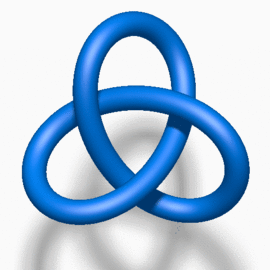
The trefoil knot is this famous knot:
Proof: The braid group is the fundamental group of the configuration space of $n$ distinct, unlabeled points in the plane. We think of these points as complex numbers $z_1,\dotsc,z_n \in \mathbb C$. By translating and dilating a collection of such points, we find that a homotopy equivalent configuration space is that for which the points have center of mass at the origin and which satisfy a chosen equation on their norms. For our $n=3$ case then, we will recognize the 3-strand braid group as the fundamental group of the space
\begin{equation*}
\left\{ \{z_1,z_2,z_3\} \subset \mathbb C \mid z_i \ne z_j, z_1+z_2+z_3=0, |z_1z_2+z_2z_3+z_3z_1|^2 + |z_1z_2z_3|^2 = 1 \right\}.
\end{equation*}
The last condition may seem strange, but it becomes more natural if we think of the three complex numbers as the roots of a monic cubic polynomial. Let $Disc_z(p(z))$ denote the discriminant of a polynomial $p$. Then our space is
\begin{equation*}
\{ z^3 + az+b \mid Disc_z(z^3+az+b) \ne 0, |a|^2+|b|^2 = 1\}.
\end{equation*}
In this case, this finally lets us see the space as
\begin{equation}
\{(a,b) \in \mathbb C^2 \mid |a|^2+|b|^2 = 1, -4a^3-27b^2 \ne 0 \} \subset S^3. \end{equation}
The space here is the subset of the unit 3-sphere $S^3 \subset \mathbb C^2$ that lies outside of some polynomial variety. The particular polynomial here cuts out a $(2,3)$-torus knot, better known as the trefoil. $\blacksquare$
This technique of intersecting spheres with algebraic varieties has a distinguished pedigree, however. First, note that the curve $-4a^3-27b^2$ is singular. If you consider a singular node of an algebraic curve locally it looks like the curves $xy=0$ or $x^2+y^2=0$ (in $\mathbb{C}^2$). This consists of two smooth arcs intersecting to each other transversally (reducible in particular).
Now, one step further, if we consider a cusp which is analytically equivalent to the origin in the curve $x^3+y^2=0$ in $\mathbb{C}^2$, it is locally irreducible. Intersecting the singularity with a small ball gave rise to the trefoil.
I think it's a reasonable question to ask what sort of manifolds one can get via this procedure. In the 3-manifold case, Sullivan sketches a proof that the link of a point on a complex algebraic surface has the property that the alternating trilinear form $\mu$ on $H^1$ given by cup product must be zero, hence ruling out the 3-torus as such a link. This uses resolution of singularities to show that the 3-manifold must bound a 4-manifold $W$ such that the intersection pairing on $H_2(W)$ is negative definite, so $H^2(W, \partial W) \to H^2(W)$ is an isomorphism. The long exact sequence of a pair then implies that $H^1(W) \to H^1(\partial W)$ is a surjection, so to calculate cup products in the boundary one can do so in $W$ and then restrict. But since $H^2(W, \partial W) \to H^2(W)$ is an isomorphism, $H^2(W) \to H^2( \partial W)$ is the zero map, whence $\mu$ is zero.
In general it doesn't seem obvious how to classify what one might get out of this procedure, and there seems to be no substitute for direct calculation. I have, however, not said what category I have been talking about. The above argument was topological, but in the smooth category there is an amazing
relation between topology and algebraic geometry that I quote from this MO answer. The underlaying space
topological space in $\mathbb{C}^5$ of the Brieskorn variety defined by the equation $x^2+y^2+z^2+w^3+t^{6k-1}=0$ is a manifold! Carrying out the intersection with a small sphere around the origin, for one may get all the 28 possible exotic differential structures on the 7-sphere that Milnor found!


Comments
Post a Comment