Local-to-global for Apollonian circle and sphere packings
A famous theorem due to Apollonius of Perga (262–190 BC) asserts that if three mutually tangential circles are given in the plane, then there are exactly two circles tangential to all three. This fact enables us to construct recursively an infinite packing using circles, called an Apollonian circle packing, or an Apollonian gasket.
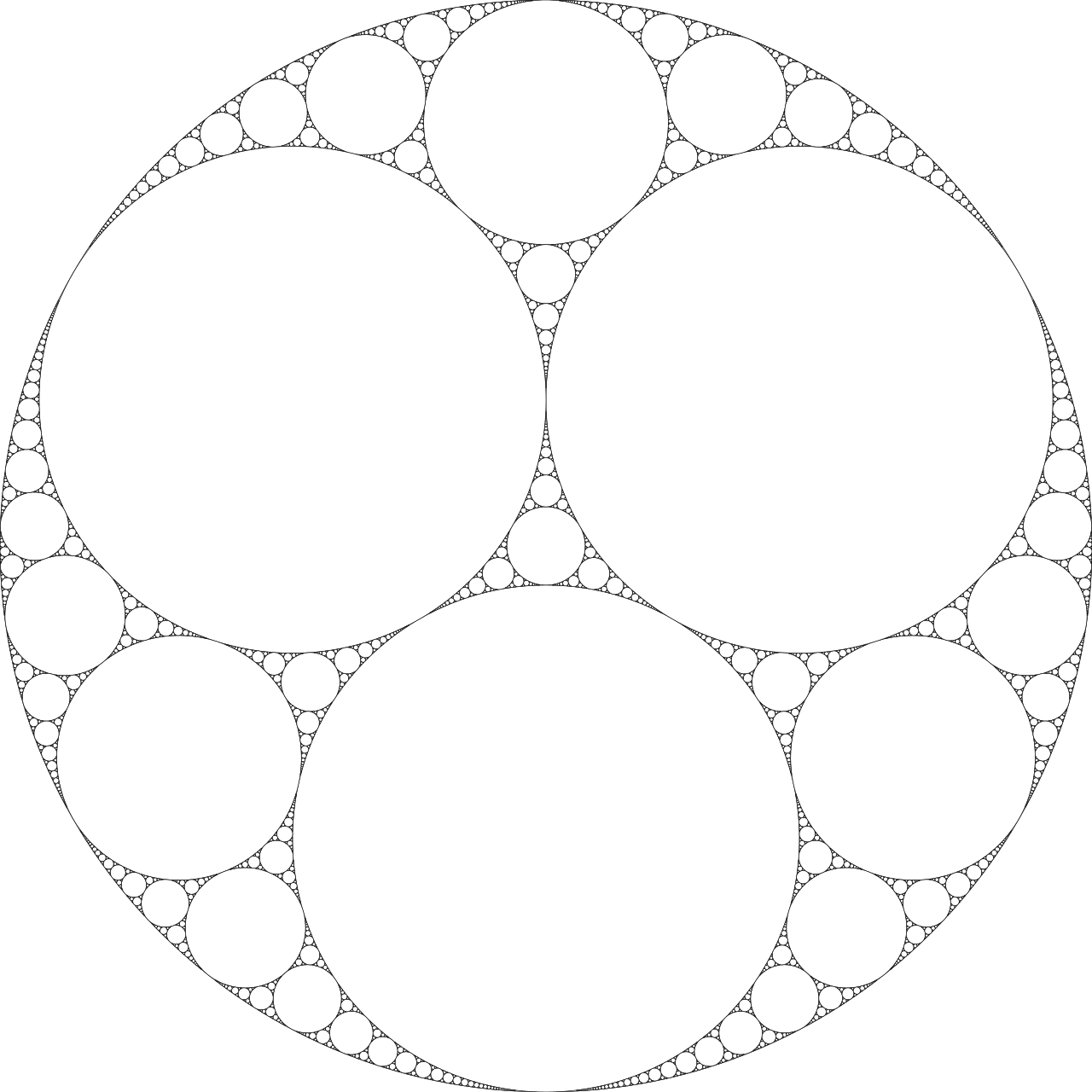
Figure from Wikipedia of an Apollonian gasket.
The size of each new circle is determined by Descartes' theorem: for any four mutually tangent circles in the plane of radii $r_i$, the $a_i:=r_i^{-1}$ satisfy of the circles obeys the equation \[2(a_1^2+a_2^2+a_3^2+a_4^2)=(a_1+a_2+a_3+a_4)^2\]
These $a_i$ are called the bends of the packing. This equation may have a solution with a negative radius; this means
that one of the circles (the one with negative radius) surrounds the
other three.
One or two of the initial circles of this construction, or the circles
resulting from this construction, can degenerate
to a straight line, which can be thought of as a circle with infinite
radius. When there are two lines, they must be parallel, and are
considered to be tangent at a point at infinity.
The 3-dimensional generalisation to spheres
asserts that given four mutually tangential spheres with disjoint
points of tangency, there are exactly two spheres tangent to the given
spheres. To see this, take a point $p$ of tangency of two given spheres and reflect the configuration through a sphere centred at $p$. Thus $p$ is sent to $\infty$, and the resulting configuration consists of two tangent spheres wedged between two parallel planes; whence the two solutions are obvious. As in the gasket case, repetition leads to a packing of 3-space by spheres. The analogue of Descartes' theorem is
\[3(a_1^2+a_2^2+a_3^2+a_4^2+a_5^2)=(a_1+a_2+a_3+a_4+a_5)^2\]
Kontorovich calls these Soddy sphere packings as the radiochemist Frederick Soddy was the first one to consider packings with all integer bends, but notes that some form of this was seen in Sangaku problems dating back to 1798. Soddy famously rediscovered Descartes' theorem and wrote a poem which was published in Nature:
For pairs of lips to kiss maybe
Involves no trigonometry.
‘Tis not so when four circles kiss
Each one the other three.
To bring this off the four must be
As three in one or one in three.
If one in three, beyond a doubt
Each gets three kisses from without.
If three in one, then is that one
Thrice kissed internally.
Four circles to the kissing come.
The smaller are the benter.
The bend is just the inverse of
The distance from the center.
Though their intrigue left Euclid dumb
There’s now no need for rule of thumb.
Since zero bend’s a dead straight line
And concave bends have minus sign,
The sum of the squares of all four bends
Is half the square of their sum.
Returning to mathematics, many questions on Apollonian circle packings are studied in terms of the
so-called integral Apollonian group, which is a certain thin subgroup
of the integral points of the orthogonal group of a rational quadratic
form with signature
Much as the values of squares are constrained modulo $n$ for any $n$, the quadratic form gives rise to local congruence obstructions for an integer to be a bend. Interestingly, the number of spheres in a packing with bend at most $N$ (counted with multiplicity) is asymptotically equal to a constant times $N^{\delta}$, where $\delta$ is the Hausdorff dimension of the closure of the packing. Soddy packings are rigid (one can be mapped to any other by a conformal transformation), so $\delta$ is a universal constant approximately 2.4739. Kontorovich proved the very nice result that
The Local-Global Theorem for sphere packings: The bends of a fixed primitive, integral Soddy sphere packing \(\mathcal{P}\) satisfy a local-to-global principle. That
is, there is an effectively computable \(N_0 = N_0(\mathcal{P})\) so
that, if \(n > N_0\) and \(n\) is admissible, \(n \in \mathcal{A}\),
then \(n\) is represented, \(n \in \mathcal{B}\).
This means that the local obstructions are, up to some possible finite set of exceptions, the only obstructions. This is reminiscent of the Hasse-Minkowski theorem, and is made all the more impressive by the fact that we are dealing with a thin subgroup: being Zariski-dense means the group 'sees' a lot while at the same time being 'small' in the sense that the index is infinite.
For the proof, Kontorovich studies the action of the Soddy group extended to act on hyperbolic 4-space, with quotient an infinite volume hyperbolic 4-fold. By a rather clever calculation, he finds that \(\Gamma\) contains a congruence Kleinian subgroup \(\Xi\). A consequence is that the set \(\mathcal{B}\) of bends contains the ``primitive'' values of a shifted quaternary quadratic form (and moreover an infinite family of such). By some analytic number theory arguments, he shows that these satisfy the Hasse principle, from which the local-global theorem follows.
So what about circle packings?
In her PhD thesis, Fuchs showed that the local obstructions for circle packings are all mod 24. Building on work of Bourgain-Fuchs, Bourgain-Kontorovich showed that the local-global
conjecture for circle packings holds for almost every \(n\), specifically that the number of
exceptional \(n\) up to \(X\) is bounded by \(X^{1-\delta}\) for some
\(\delta > 0\).
In the words of Ben Green, the latter paper "involves a bewildering array of techniques including, but not limited
to: results of Patterson, of Lax and Phillips and of Sullivan on the
spectrum of the Laplacian of the infinite-volume quotients of
Nevertheless, it turns out that the local-global conjecture for circle packings is false! Quanta wrote an article about this. There are circumstances where admissible
values of certain quadratic or quartic polynomials are missing from \( B
\), giving arbitrarily large local-global failures.
Definition: Let \( S_{d,u} := \{un^d : n \in \mathbb{Z}\}, u, d
> 0 \). We say that the set \( S_{d,u} \) forms a reciprocity
obstruction to \( A \) if infinitely many elements of \( S_{d,u} \) are
admissible in \( A \) modulo 24, and yet no element of \( S_{d,u} \)
appears as a curvature in \( A \). If \( d = 2 \), call it a quadratic obstruction, and if \( d = 4 \), it is a quartic
obstruction.
It is clear that if there
exists a reciprocity obstruction for a circle packing \( A \), then the local-global
conjecture cannot hold for \( A \), and more specifically, for any
of the admissible residue classes intersecting \( S_{d,u} \).
By completely elementary methods, Haag-Kertzer-Rickards-Stange show that there exists a function
\[
\chi_2 : \{\text{circles in } A\} \to \{\pm 1\},
\]
which
is constant across \( A \). In particular, this gives a well defined
value for \( \chi_2(A) \). Furthermore, there exists a function
\[
\chi_4 : \{\text{circles in a packing } A \text{ of type } (6,1) \text{ or } (6,17)\} \to \{1,i,-1,-i\},
\]
which satisfies \( \chi_4(C)^2 = \chi_2(C) \), and is also constant across a packing, defining \( \chi_4(A) \).
The
value of \( \chi_2 \) determines the quadratic obstructions, and \(
\chi_4 \) the quartic ones. In the simplest cases, \( \chi_2(A) = \left(\frac{b}{a}\right)
\) for any coprime pair of curvatures \( a \) and \( b \) of tangent
circles in \( A \). The definition of \( \chi_4 \) relies on a finer
invariant using the quartic residue symbol. The constancy across a
packing follows from quadratic and quartic reciprocity. Then, for example, when the quadratic symbol is \(-1\), the entries
cannot be perfect squares.This idea has already been used to disprove local-global conjectures for other types of packings. Kontorovich remarks that this is a rare instance of quartic reciprocity arising ``in nature''. The authors
give a complete list of reciprocity obstructions of this new type, and
conjecture that every sufficiently large admissible number not ruled out
by such occurs in \( B \), giving some computational evidence.
Definition: The
(extended) type of \( A \) is either the triple \( (x,k,\chi_2) \) or
\( (x,k,\chi_2,\chi_4) \), where \( A \) has type \( (x,k) \) and
corresponding values of \( \chi_2 \) (and \( \chi_4 \), if relevant).
Haag-Kertzer-Rickards-Stange show
Proposition: Let \( R(A) \) be the set of residues modulo 24 of the curvatures in \( A \). Then \( R(A) \) is one of six possible sets, labelled by a type as follows:

Figure from the paper
The set \( R(A) \) is called the admissible set of the packing. The type \((x, k)\) denotes that \( R(A) \) has cardinality \( x \), and the smallest positive residue in \( R(A) \) coprime to 24 is \( k \).
This sinks the conjecture! Note the resemblance to the Hasse-Minkowski theorem: one needs sufficiently many variables to prove a local-global principle, and similarly here this is reflected in the quadratic form from Descartes' theorem having too few variables. Kontorovich ends his mathscinet review by saying "What is perhaps most fascinating of all is that these obstructions occur in the orbits under the Apollonian group only, and not in orbits of the full integer automorphism group of the Descartes form, so they are a truly novel, arithmetic/group-theoretic phenomenon." We will hopefully return to this theme on this blog too.


Comments
Post a Comment